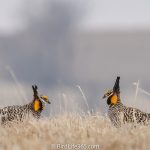
I recently got back from a trip to Nebraska. The main purpose for this springtime journey is to see the Sandhill cranes on the Platte river. But another bird that is always a treat to see is the Greater Prairie Chicken, known scientifically as Tympanuchus cupido.
It may seem odd that a guy from Iowa travels to it’s neighbor to the west to see chickens. Truth is though, although this bird numbered literally in the millions at one time in Iowa…there is only one main group that remains here now. This re-established flock came through a reintroduction program conducted by the Iowa DNR.
Decimated by excessive hunting, and mostly habitat loss of their native grasslands, the birds were wiped out with the last bird seen in Iowa in 1952. No other landscape in the U.S. has changed as much as Iowa has. Native prairie became cropland, and the Prairie Chicken simply could not adjust to that. A reintroduction program got underway in the early 1980’s and established a small flock on the Kellerton Grasslands in Southwest Iowa.
Nebraska, in contrast, has maintained a good population of the birds, so much so, that they are still hunted there. The Cornhusker state certainly has plenty of farm land now, but along with that, the sandhills region as well as other areas still have ample grassland available for the birds to nest.
One of the most remarkable aspects of the Greater Prairie Chicken is its mating display, known as “booming”. During the breeding season, males gather on display grounds called leks, where they perform elaborate dances to attract females. These dances include inflating orange air sacs on their necks, producing deep, resonant booming sounds, and performing rapid foot-stomping moves. This extraordinary display is not only visually captivating but also serves as a critical mechanism for mate selection.
The Prairie Chicken has held importance in North American culture, particularly among Native American tribes, who revered the bird and incorporated it into their dances and ceremonies. The bird’s booming display and other behaviors have inspired cultural traditions and artistic representations